Documentation
We recommend that users new to BrainVoyager QX start with working through the Getting Started Guide (GSG) to learn about the most important basic analysis tools. To download the GSG, click on the link below. After downloading the file, unzip it to get the contained PDF document. If you can not open the PDF file, download the free Acrobat Reader. The Getting Started Guide 2.7 matches version 2.0 of BrainVoyager QX.
| BVQXGettingStartedGuide_v2.11.pdf (14.8 MB) |
Overview Publication
The papers below may be helpful to get a general overview of standard as well as advanced features of BrainVoyager QX.
| Goebel, R. (2012).BrainVoyager - Past, Present, Future |
| Goebel_etal_Preprint_HBM2006.pdf |
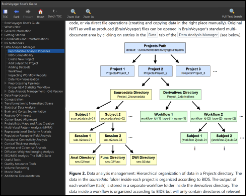
The "BrainVoyager QX User's Guide" provides an in-depth explanation of all major features of the software. It is available from BrainVoyager by clicking on the "User's Guide" item in the "Help" menu. You may also view the User's Guide online by following this link:
| Online User's Guide |
In order to download the User's Guide to your computer, click the following link:
| BVQX_UsersGuide_v26.zip (58.1 MB) |
In order to be available from BrainVoyager's help menu, the content of the downloaded zip file has to be copied in the "UsersGuide" folder which is located in the BrainVoyager QX folder.
Note: Downloading the User's Guide is usually not necessary since it is automatically stored on your computer during installation of BrainVoyager QX.
Referencing BrainVoyager QX
The "Goebel et. al. (2006)" paper above may be used as a general reference to BrainVoyager QX in your publication. In the "Methods" section, you can write something like this:
"BrainVoyager QX [version number] (Brain Innovation, Maastricht, The Netherlands) was used for fMRI [DTI / EEG / MEG] data analysis (Goebel et. al., 2006)."
In your "References" section, you can then cite the paper as:
Goebel, R., Esposito, F. Formisano, E. (2006). Analysis of functional image analysis contest (FIAC) data with Brainvoyager QX: From single-subject to cortically aligned group general linear model analysis and self-organizing group independent component analysis. Human Brain Mapping, 27, 392-401.
The "Goebel et. al. (2006)" paper above may be used as a general reference to BrainVoyager QX in your publication. In the "Methods" section, you can write something like this:
"BrainVoyager QX [version number] (Brain Innovation, Maastricht, The Netherlands) was used for fMRI [DTI / EEG / MEG] data analysis (Goebel et. al., 2006)."
In your "References" section, you can then cite the paper as:
Goebel, R., Esposito, F. Formisano, E. (2006). Analysis of functional image analysis contest (FIAC) data with Brainvoyager QX: From single-subject to cortically aligned group general linear model analysis and self-organizing group independent component analysis. Human Brain Mapping, 27, 392-401.
To view or download the BrainVoyager TMS Neuronavigator User Manual, use the link below. Depending on your Internet browser, a simple click on the link will most likely open the guide in the browser window. If you can not open the PDF file, download the free Acrobat Reader. For saving the file to disk, a "Save to disk..." or similar option is usually available in a context menu.
| BrainVoyagerTMSNeuronavigator_UserManual_v3.pdf |
Referencing Specific Features
For citing relevant papers on specific methods (e.g. Granger Causality, ICA, Cortical Thickness Analysis, (functional) CBA, SVM, searchlight, TMS, EEG/MEG), consult the Publications page.
If you have any questions about documentation not answered here, please send an email to "support _at_ BrainVoyager _dot_ com".